


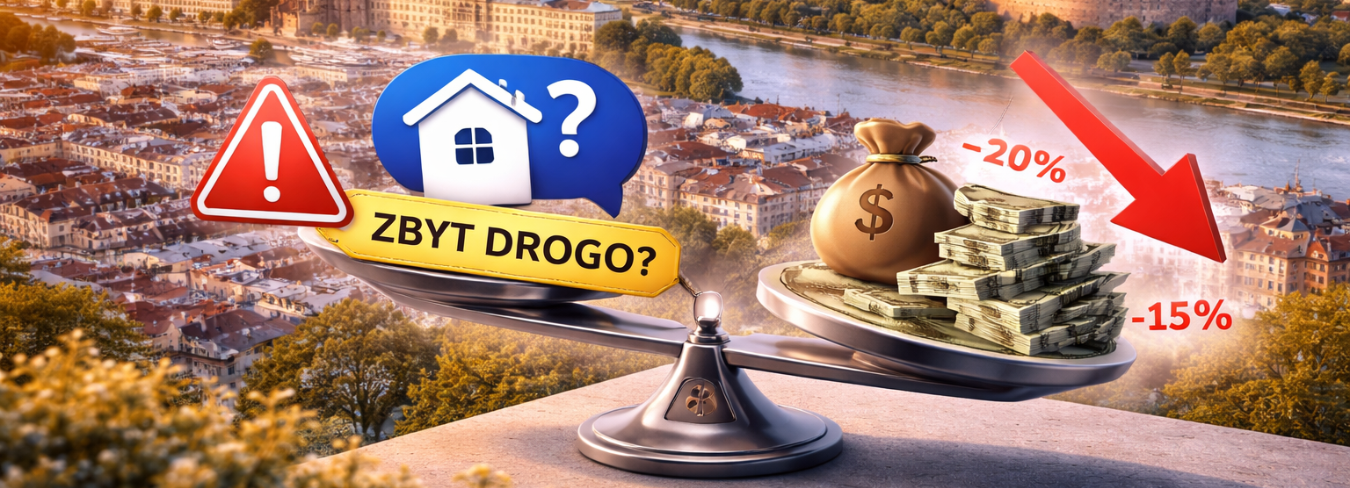
The real estate market in Krakow has been stirring up a storm for several years now. Dynamic price increases, rising mortgage costs, and limited housing availability are leading more and more people to ask themselves one key question: are we dealing with a bubble or simply a new pricing reality?
Analyzing Krakow apartment prices, one can observe a clear upward trend, which does not always coincide with rising incomes. This disparity becomes the main argument for those who support the thesis of market overvaluation.
In this article, we will analyze the data, indicators and real factors influencing apartment prices in Krakow.
Is there a real estate bubble in Krakow?
The term "bubble" refers to a situation in which asset prices rise faster than their real value, with demand driven primarily by speculation. In practice, this means there's a risk of a sharp correction.
From the perspective of local experts and companies such as real estate agency Krakow, the market is still based on real demand, not solely on speculative investors. A large number of transactions stem from actual housing needs – migration to the city, work, education, or changing living standards.
This is an important difference from classic speculative bubbles.
Price-to-income ratio – are apartments affordable for residents?
One of the most important indicators for assessing the market is the price-to-income ratio, i.e. the ratio of the apartment price to the average income.
In Krakow:
- housing prices rose faster than wages,
- credit availability has deteriorated,
- the required own contribution has become a barrier for many buyers.
The new apartment segment in Krakow is particularly visible in this regard, as the prices of new investments often exceed the affordability of the average household.
Compared to EU countries, Krakow is starting to approach the levels of large metropolises, even though average incomes are lower.
Price-to-rent ratio – does the rental justify the prices?
Another key indicator is the ratio of property price to potential rental income.
Analyzing apartments for sale Krakow, it can be noticed that:
- purchase prices are rising faster than rental rates,
- the profitability of investments is decreasing,
- the payback period is longer.
This is a signal that, in a traditional analysis, might suggest an overvaluation. However, in Krakow, stable rental demand plays a significant role – students, foreign workers, and the IT sector continue to generate demand.
Comparison to 2008 – is the situation repeating itself?
Many analysts compare the current situation to the crisis of 2008, when the real estate market in many countries suffered a sharp collapse.
Looking at the Krakow new apartment segment, you can notice several key differences:
- banks apply more restrictive lending rules,
- developers are acting more cautiously,
- there is no large-scale oversupply of apartments.
This means that the market fundamentals are much more stable today than before the previous crisis.
Real availability of apartments – who can buy today?
One of the most important market problems is the availability of apartments for the average buyer.
Analyzing Krakow apartment prices, it is clearly visible that:
- young people have more and more problems with shopping,
- creditworthiness limits the number of potential buyers,
- the importance of family support or home equity is growing.
In practice, this means that the market is becoming increasingly divided between people who can buy an apartment and those who remain in the rental segment.
Investor influence vs. end-user buyer
One of the frequently repeated arguments is the influence of investors on housing prices. In Krakow, investors still play an important role, but they do not completely dominate the market.
Professional real estate agency points out that:
- a large part of purchases are for personal needs,
- investors act more selectively,
- the importance of long-term rentals instead of speculation is growing.
This means the market is not driven solely by investment capital, which reduces the risk of a sharp correction.
Are prices artificially high?
The answer is not clear.
On the one hand:
- prices are rising faster than incomes,
- housing availability is decreasing,
- investments become less profitable.
On the other hand:
- demand remains high,
- Krakow attracts new residents,
- Limited land supply affects prices.
This points to structural growth factors rather than artificial market inflation.
Is it worth waiting for prices to drop?
This is a key question for people planning to purchase.
The history of the real estate market shows that:
- price adjustments are possible,
- but they are rarely deep and long-lasting,
- Market timing is very difficult.
In practice, the purchase decision should depend more on your individual financial situation than on trying to predict the market.
Is this a bubble or a new pricing standard?
This is the most important conclusion from the entire analysis.
The current situation in Krakow does not meet all the criteria for a classic speculative bubble. It is not visible:
- mass speculation,
- excessive household debt,
- oversupply of apartments.
Instead we observe:
- sustained demand,
- limited supply,
- the growing attractiveness of the city.
This suggests we are dealing with a new pricing norm rather than a short-term bubble.
Conclusions
Are Krakow apartment prices overvalued in 2026? Partly, yes – especially given residents' incomes and declining affordability.
However, the market isn't showing classic signs of a bubble, and its fundamentals remain relatively stable. The final answer depends on perspective:
- for the buyer – prices may be high and difficult to accept,
- for the investor – the market still offers stability,
- for the analyst – it is a new equilibrium rather than overheating.
The most important thing is to make decisions based on data, not emotions or media headlines.